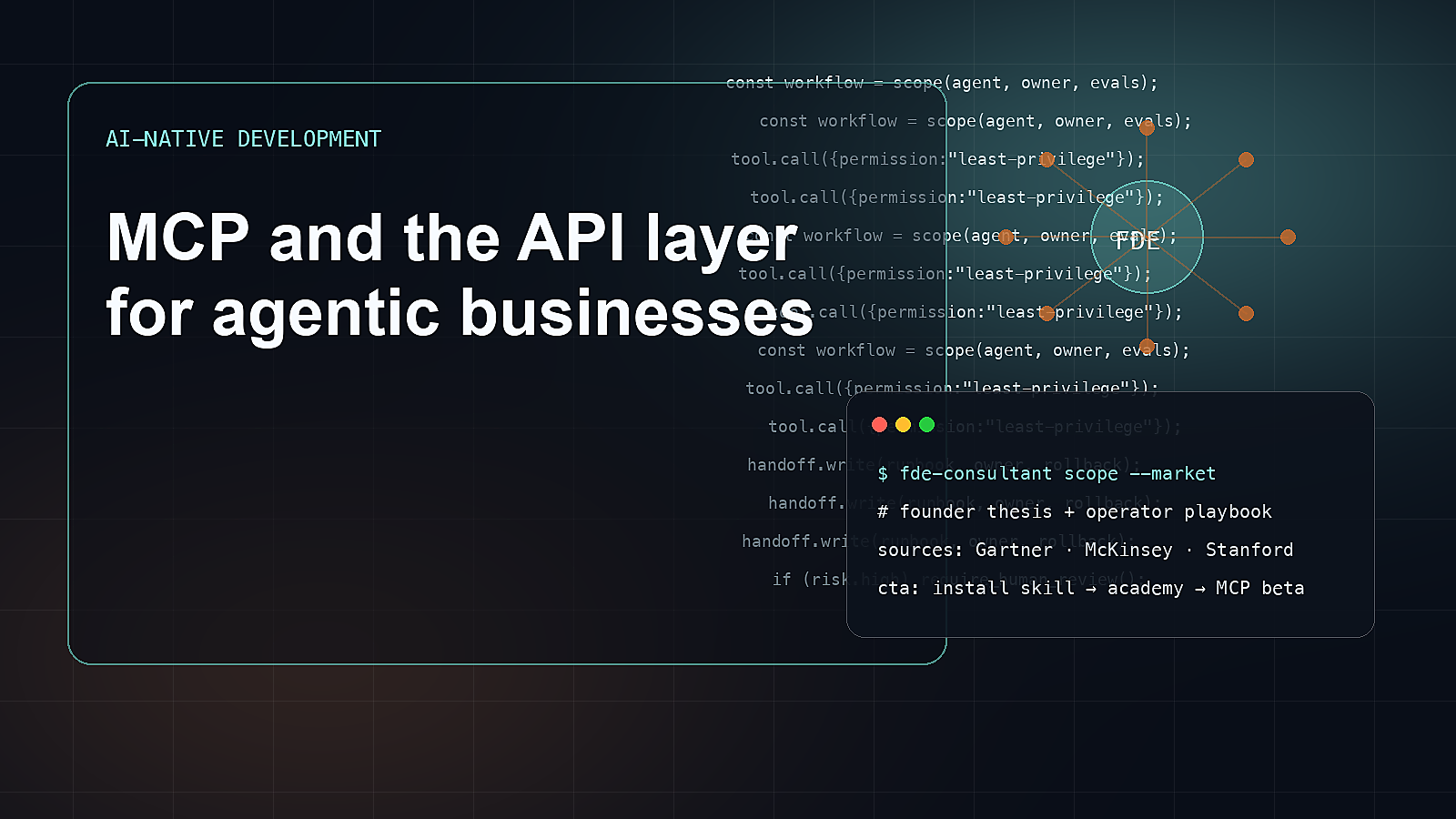
MCP and the API layer for agentic businesses
MCP is important because agents need more than text. They need scoped access to tools, resources, prompts, and workflows. For founders, MCP is becoming the API layer of agentic businesses.
The useful way to read the current AI market is not as a sequence of model launches. It is a shift in how work is specified, delegated, verified, and owned. MCP and the API layer for agentic businesses matters because Model Context Protocol becoming an integration layer for AI applications changes where value is captured. A founder who only watches model benchmarks will miss the operational layer: who decides what the agent should do, what context it can use, what tools it can call, what counts as failure, and how the result is handed to a team that must live with it after the demo.
The timing is important. The official MCP docs describe the protocol as an open standard for connecting AI applications to external systems, including data sources, tools, and workflows. That maps directly to FDE: context, action, and process. Generative AI has become mainstream fast enough that buyers now know the language but not necessarily the implementation discipline. That creates a strange market: more companies can imagine AI use cases, yet many still cannot explain the process, data, error cost, current baseline, or success metric. This gap is exactly where forward deployed engineering becomes commercially relevant.
For a founder, the market context should change product strategy. If Model Context Protocol becoming an integration layer for AI applications is real, the winning product is not merely a UI that makes a model easier to access. The product must reduce uncertainty for a buyer. It must show how the workflow is selected, how the agent is constrained, how outputs are checked, and how the customer team maintains the system.
The winners in this category will be businesses that expose narrow, auditable agent tools, MCP servers with auth, logging, and least privilege, teams that connect MCP to evals and runbooks. They will sound less like hype machines and more like field teams: specific, measurable, grounded, willing to say no. The strongest companies will know when not to use an agent, when to require human review, when to stay local-first, and when a workflow is mature enough for a hosted tool layer.
The losers will be servers that expose broad shell-like power without governance, founders who confuse protocol adoption with product value, agent workflows that lack approval gates. Their failure will not always look like a broken demo. Often it will look like a pilot that never becomes owned software, a customer success story with no baseline, or a beautiful interface that cannot pass procurement because security, data, ownership, and monitoring were treated as afterthoughts.
Compounding advantage
- businesses that expose narrow, auditable agent tools
- MCP servers with auth, logging, and least privilege
- teams that connect MCP to evals and runbooks
False starts
- servers that expose broad shell-like power without governance
- founders who confuse protocol adoption with product value
- agent workflows that lack approval gates
How to act on this trend
- Start with read-only resources before write tools.
- Define one tool per business action, not one universal executor.
- Attach permissions to the user and workflow.
- Log tool calls for audit and debugging.
- Connect tool success to evals.
- Keep MCP Bêta honest until production hardening is real.
Market evidence
Install the method before the platform
Use this article as strategic context, then install the open-source Skill and make your agent produce FDE artifacts before implementation.